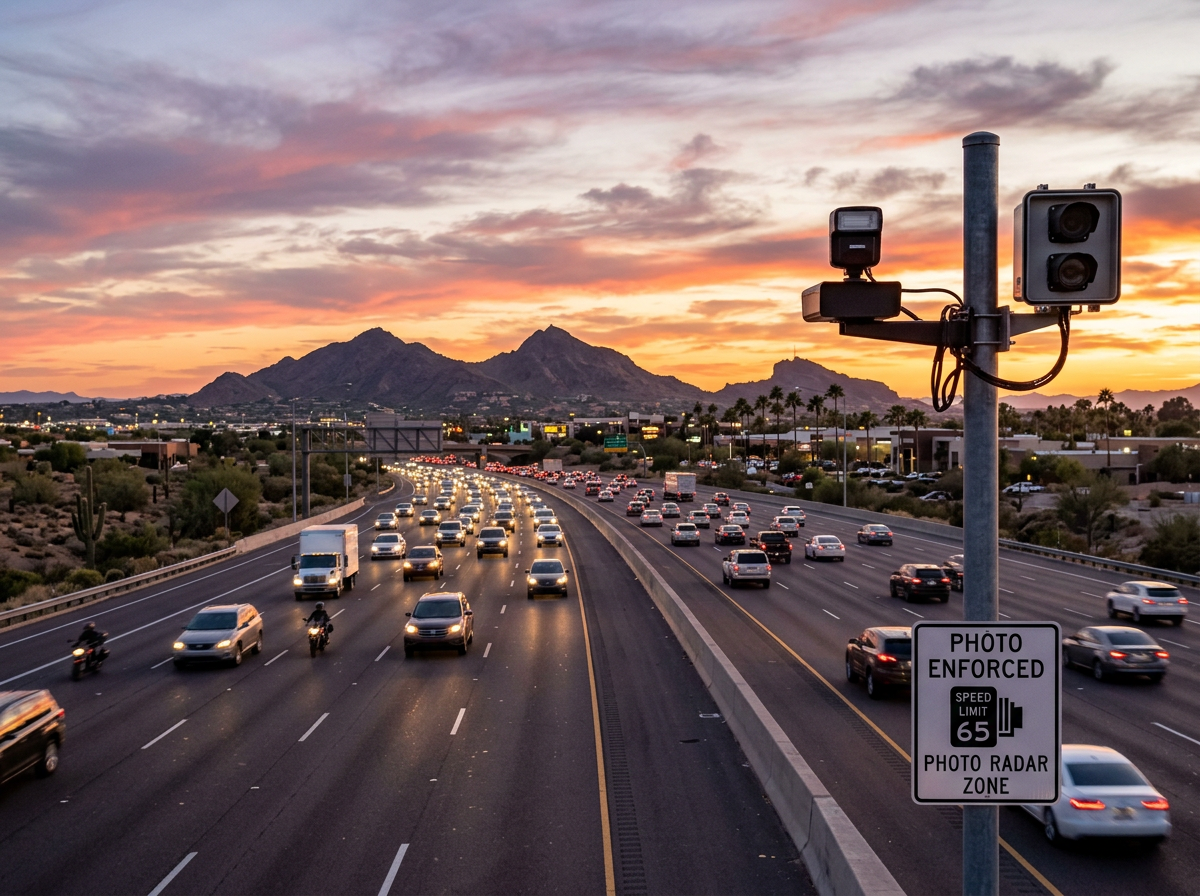
Photo radarPhoenix recently introduced Photo Radar Cameras on a number of the major highways around the city: stationary camera setups photograph vehicles, and their drivers, that exceed the posted speed limit by more than 11MPH. Various organizations and some legislators immediately took up the gauntlet opposing the use of the cameras… a cause celebre. I guess I don’t fully understand what is going on because the use of these devices strikes me as a good thing.. even in considering the “negatives” being pushed.

Here is my opinion:

Radar war
1.   Photo radar slows down traffic on very busy, often over- congested, highways. This in turn cuts down on accidents and saves lives. Truth be known, if you drive a lot in Phoenix (I commute daily and make many trips from north Phoenix to the airport south of town), you would be a HUGE advocate of anything that slows down the crazies on our roads. Why is this a bad thing?

2. Those opposing say that it is just a scheme to bring money into the government’s severely depleted coffers at the expense of drivers. I’m sorry, but where is it wrong that if you exceed the speed limit… a violation of the law… you have to pay a fine? I think this is a GOOD thing: why not help balance the budget by fining those who break the law? You don’t like the speed limits? Go through the government processes to get them changed, but until then, the last time I checked posted speed limits are the law and those breaking the law should expect to be penalized if caught.

3. Some complain that the “flashes” from the camera lighting will cause accidents. I have driven by the photo radar sites late at night, seen the flash from the camera and somehow managed to survive… truth be known, it had no effect on my driving!

4.   Another complaint: the photo cameras force people to slow down and that creates more hazards on the roads because of slower moving traffic. Nah, I don’t think so: my experience with the photo radar locations is that EVERYONE slows down, thus no hazard. Not to mention that the idiot zipping in and out of traffic at considerably over the speed limit is a much bigger hazard.

5. How about “drivers will realize they are at a photo radar camera, slam on their brakes to slow down and cause other drivers to back-end them.” That is just ludicrous. I have not heard about or seen a report of a single incident justifying this contention. Come on: there are even signs 1/2 mile and 300 yd before the photo radar locations warning drivers they are coming up on a photo shoot. Anyone driving that fast needs to be off the roads anyway.

6. Some argue that it depersonalizes law enforcement. OK, maybe it does… so what? Break the law, pay the fine. ‘Strikes me as just a more efficient way to catch speeders.

7. And then there are those that claim Invasion of Privacy. Ridiculous: you have no expectation of privacy when driving on a public thoroughfare and certainly none when breaking the law in public.


8. The hardware makes mistakes. So? The same can be said for the Law Enforcement guy sitting in his car holding a radar gun. This is the ONLY argument that would give cause to question Photo Radar Cameras, but I have not seen anything documenting any pattern of inaccuracies. Besides, if you think you have been wronged, you can still have your Day In Court, just as if a cop had stopped you.


Conclusion: this strikes me as Win-Win situation: decrease accidents while helping our budget by fining law breakers. It is a good thing… even if I get tagged by one of the cameras!

January 24, 2009

16 responses to “Photo Radar Cameras… duh, what am I missing…”

  1. Nice try Bill. You’re a tool, plain and simple.

  2. The response of someone who has no valid response.

  3. There is never a good reason to sacrifice liberty for safety. If safety is so important, we should all be living in self-contained government dormitories where no one needs to go anywhere for anything, and you have to get permission to go or to have visitors come in. After all, that would be the only way to guarantee all of us complete safey right?
    Sorry. I’m not willing to give away my freedom for a little safety. I’m also smart enough to realize that the guy next to me going 5mph over the limit is much less a risk to me than the person next to him talking on their cell phone or trying to eat a Big Mac while driving, or the teenager or elderly driver behind them.
    There’s a website that completely addresses all of the bad things about PhotoRadar and it is http://PhotoRadarScam.com
    Not only are the safety claims false, but in many cases, cameras cause an INCREASE in accidents. Who would support a device the causes more accidents? Additionally, the municipalities that are installing cameras are not exhausting non-intrusive engineering solutions before resorting to cameras. Plenty of improvements can be made to improve safety on roads and intersections without installing cameras. If anything, cameras should be a last resort, not a first resort.
    And by the way, here is Sheriff Babeu of Pinal County claiming that fatalities doubled where cameras were installed. Kind of scary. http://www.azfamily.com/video/3tvextra-index.html?nvid=324071&shu=1

  4. I advocate banning all but hands-free cell phone use, making nuisance/ distractions (eating, etc) a violation and periodic license renewals with testing.
    Sacrifice liberty? That just doesn’t cut it. If you wish to worry about sacrifices of liberty, be concerned about what our government is doing with human rights or the intrusive tax laws or pervasive invasions of privacy though institutional use of monitoring technology or even silly HOA rules, but not having your picture taken as you drive down the road by a camera whose action is based on a violation of the law!
    If the loud noises made by those opposed to photo radar have any affect at all, it will be to provide a Loyal Opposition that will, in fact, keep the use of Photo Radar from being anything more than a way to catch speeders and keep the company’s contracted to manage the process honest.
    I would hardly call the use of photo radar cameras a first resort but certainly agree that much can be done with improving the safety of our roads, including doing a better job teaching driving skills and reviewing antiquated road rules.
    Only time will tell on the safety issue. As usual, both sides can trot out their “experts.” I prefer the logic of safety through compliance with existing laws.

  5. The Kangaroo Court that is Photo Radar simply sets State sponsored traps that generate revenue.
    National studies conclude the safety aspects are outweighed in terms of property damage and loss of life due to increased collisions.
    The addiction to easy money for the municipality often back fires when those who get tickets in the mail simply fail to respond and force the state to hire a server who has to track down them down. When those who are served do not cave in to the intimidation and demand a court hearing, it overwhelms the courts in short order. When the people catch on to the scam and confront their real accuser, the state, the profitability of the program goes negative. Then the State finds out, the dirty money they thought they were going to have costs them instead.
    Then the cameras come down.

  6. So…you have no opinion on the fact that they are recording 24/7 and archiving data on completely innocent motorists and passersby? And you’re OK with the fact that there is no legal basis for them to do this and there is no indication of what this information can be used for (by this 3rd party non-governmental foreign-based corporation? I ask you this– sure I have no reasonable expectation of privacy, that’s a given. But why is my personal data being collected and retained if I have done nothing wrong? Even neglecting any privacy issues, there’s still the small issue of probable cause, and the fact that it is now effectively suspended! Last time I checked, that law is still on the books.
    Next I think it is interesting that you specifically state that at least in part (a large part in my opinion) this is about the money. Do you not see a conflict of interest when you turn law enforcement and public safety officials into tax men?
    And you’re ok with “making the lawbreakers pay,” in order to balance the budget? I’ve noted this previously over on camerafraud.com, but people who espouse this opinion make me sick. What this opinion amounts to is this: nobody likes taxes, but the government is in a shortfall. If they cannot cut the budget enough, taxes need to go up. It’s a simple formula. People love to complain, but the money must come from somewhere, and we all benefit from it.
    So when I hear someone say “let the lawbreakers pay” it verymuch implies that that person does not want to pay their fair share, and is willing to forcibly place their share on someone else. It says that they are comfortable with the thought of using our law enforcement, courts and justice system to strongarm others into paying instead of owning up.

  7. Mr. No one, re your comments:
    Opinion on recording 24/7?
    From my original post:
    “Break the law, pay the fine. ‘Strikes me as just a more efficient way to catch speeders.”
    ——————————————————
    You need to clean up your research:
    1. There is plenty of legal precedence.
    2. There are restrictions on the use of data collected.
    3. There is no evidence of collecting personal data unless you break the law (exceed speed limit by 11MPH). If there was evidence of misuse, I would strongly oppose deployment (please note my 1/24, 3:45pm, 3rd paragraph comment).
    4. What, exactly, is the personal data you think those cameras are capturing? Your license plate, where you are at a given time and how fast you are traveling? The most important “personal information” is already on record (your license plate number). Think about it for a second: what would the Evil Empire do with data of where you are when?
    5. You misunderstand the legal definition of “probable cause.” It does not apply.
    ——————————————————-
    You misconstrue “balancing the budget” comments. I have no problem with fines collected from violating the law going into government coffers. The point is that if the fines are collected, they should be put to good use. Sure, we need to clean up government spending and may need to raise taxes (although it is far more complex than your “simple formula”). None of these are an end-all solution. To think otherwise is childish and simplistic.
    Your interpretation of the implication of “let the lawbreakers pay” is pathetic, arrogant and wrong. It is false to say that it implies an abrogation of responsibility or an unwillingness to pay one’s fair share. How you made that absurd leap is baffling.
    Your last sentence is absurd.

  8. It’s pathetic Bill, you’re like all of the other camera supporters. You claim that cameras are safer but you never post any sources or studies to back up your arguments. I don’t claim to be an expert, I just know what I read and see from the credible sources I have posted. You have yet to address any of these specifically to say why my sources are not valid. I’d like to know why you think Seriff Babeu in Pinal County is wrong about his stats of fatalities doubling where the cameras are installed. I’d like to know why you think the data at safespeed.org.uk is invalid or that the NHTSA vehicle crash causation survey is flawed.
    So where are you sources? What makes you such an expert that we should just take your arugments at face value?

  9. On the camerafraud.com page from which you linked to this post, there is an article which specifically states the cameras are on 24/7 and have a live feed archived for a minimum of 90 days. Translated, this means they are recording every person whether breaking the law or not. It is also known that they have facial recognition software, capable of determining your identity, and that some areas are actively seeking “suspected felons” which means they must have some access to government databases.
    This is a lot of information to be captured on every last inndividual, simply in order to catch a speeder or two. And if there are restrictions on its use, I have yet to see them- care to cite a source?
    And I am sorry if you believe my argument on taxes is childish and simplistic, but I believe it, and I can’t see how it is anything BUT that. There is a burden, which is traditionally shared by all. It needs to be increased. You say “let them carry the increase”– how is that not pushing your load off on someone else? Please explain that one.
    I also believe that the moment we turn breaking the law into a moneymaking proposition which is required for our budget to be balanced and is spoken for ahead of time, you are opening the door to problems. What if everyone stopped speeding, or if the revenue expected doesn’t come in– then what? The budget deficit isn’t going away. I am not against fining lawbreakers to offset the considerable overhead of maintaining a police force and the costs of the justice system– but as soon as it becomes a moneymaker, to the point that the money is allocated to other areas of the government, and (more importantly) counted before it even comes in, this is at absolute best a conflict of interest.

  10. Oh, and as to #5, probable cause- we agree it does not apply– but my question is why not? Why should the method of enforcement alone negatively impact my rights as a citizen? I don’t believe it should!

  11. Hey Bill,
    You and your ATS (or Redflex) colleagues must be getting at least a LITTLE nervous about the increasing likelihood that you’ll be losing your jobs soon. With just the little “local” contracts, there won’t be much reason to keep a US headquarters in the valley anymore.

  12. Joe,
    What in the world makes you think I have any association with ATS or Redflex?
    Just so you do not misunderstand, I should be very clear: I have nothing to do with Redflex, ATS, any civilian agency or any government agency that has anything to do with oversight or management of the Photo Radar System. I’m just a guy with an opinion.
    Does expressing a point of view automatically make me part of the clique? If you think so then you may wish to review some of my responses to the various comments posted here.
    By the way, please note that, unlike some other blogs, I have not censored any of the comments to my posting, except for the one full of profane language.

  13. To point on No One’s last missive:
    1. I’m not sure I understand the concern about the cameras running 24/7 and recording (although I doubt they actually do live feeds). There have been hi-res security cameras at intersections, on buildings in urban areas, in stores and in parking lots for years. Many of them feed directly to law enforcement and government agencies. To your specific argument of 24/7 up time and live feeds, this is different how?
    2. Your argument about taxes is simplistic: it is a complex issue with many facets, not the least of which are our antiquated tax laws which often burden those least able to handle it. Unfortunately, it is not, as you state, a matter of a “burden shared by all.” Nonetheless, equal taxation of the people is a integral part of our society and, you are correct, needs increasing.
    3. Your comment “You say let them carry the increase” is inaccurate. I never made such a statement nor ever would. The inaccuracy carries through into your next paragraph, and reflects a total misunderstanding of the financial implications and my perspective. You make whole cloth assumptions without the fabric of knowledge or understanding.
    4. You just can’t let go of probable cause, can you? It really has no bearing. “Why should the method of enforcement alone negatively impact my rights as a citizen?” Oh come on, you cannot seriously believe that question. Add it to the pile of your other absurd statements.

  14. Point by point:
    1) Traffic camers are different in many ways. In terms of stores and parking lots, or basically any privately-owned camera, a) I an choose to frequent an establishment, or not b) they do not have facial recognition software (unless you’re in a casino) c) they are looking for very specific, purposeful acts. They are not looking for a momentary slip-up, d) they are not able to fine me directly for any alleged misdeeds they believe they see and e) even if they do find something, they are not the enforcement themselves as the camera companies are. The camera company makes the ticket and DPS just rubber-stamps it based on what the company tells them. Lastly, f) it is up to the owner of the camera to prosecute, or not, and they bear the burden of proof.
    As to the idea of hi-res traffic cams, as far as I am aware (and feel free to correct me if I am wrong) they also do not have facial recognition, nor are they capturing license plates. They are also not running people’s identities up against various databases, looking for criminals. They are looking for traffic patterns in the aggregate and not focussed on individual vehicles or individuals.
    On #2: You are quite correct there, the overall subject of taxes is quite complex, and as that is not germane to the discussion I will leave it at that.
    On #3: I may be a simpleton in your eyes, but I know my household budget, when I have a shortfall I have two choices– increase income, cut expenses, or go into debt. There’s not much else. Now, when applying that to the state’s position, and taking a look at the fact that there’s WAS a projected budget shortfall of tens of millions of dollars, and they are cutting some expenses, but not to the amount required, they did NOT raise taxes (the traditional source of income for a government) and are apparently projecting a “balanced budget” (ie not going into debt.) How did they do this? They plugged the hole with the money generated from the cameras.
    Now, I didn’t hear anything from you about the government needing to cut expenses, nor did I hear anything about either raising taxes or running a deficit. What I did hear included “helping our budget by fining law breakers. It is a good thing” that’s where I got that from and that’s my reasoning. Perhaps I jumped a little from point a to point b, but certain people do hold that opinion– they are for the cameras in an effort to contain taxes– and this is an irresponsible attitude for the reasons I stated above.
    4) So probable cause has no bearing? Again I ask, why not? But allow me break down my argument. A regular policeman cannot pull anyone over without probable cause. Without the ability to pull a person over, the policeman cannot write a ticket. Therefore, probable cause has always been (until recently) an integral part of any traffic citation.
    Now, step back, and consider the implications of this. We are talking about the same law being broken in both instances– speeding caught by a policeman and speeding caught by a camera. The same laws apply, and the same laws are being broken in the same manner. Probable cause is required in one instance, but not in another. What makes the cameras immune from this requirement? I simply do not see how this question is “absurd.” (speaking of the word absurd, you need a new buzz-word.)
    and, while we’re on the subject of rights being impacted, I’ll go one better and add #5), the whole issue of service. In a normal citation, the motorist is served immediately, and the cost of that service is included in the citation. With the radar it takes weeks, or even months, to where a person may not remember if I was speeding or not. If a person either misses the mailing, or elects to exercise their legal right of being served as opposed to the less-than-legal mailings they give, the cost of the server is added on! It should have it for free and immediate, and now it is served considerably later at additional cost. Again, we’re talking about the same laws being broken in the same way, but a net difference in the rights of the person involved. I take issue with that.
    Now, feel free to call my arguments whatever you’d like, but I haven’t seen them addressed yet– either by you or anyone else. And I have yet to see sources as requested.

  15. Bill wrote:
    “There have been hi-res security cameras at intersections, on buildings in urban areas, in stores and in parking lots for years. Many of them feed directly to law enforcement and government agencies. To your specific argument of 24/7 up time and live feeds, this is different how?”
    People can record whatever they wish on their private property. And yes, the police have been capturing video of intersections and other various points of strategic interest for years. And now they have stepped it up. I would imagine that even YOU have a “threshold” that defines your limits for government intrusion in terms of monitoring your movements. How many cameras would it take before you start to feel just a bit weird about being watched?
    I’ve just noticed that they’ve installed 3 new cameras on sounthbound 17 in just a few days. I do not fear the radar (it’s been a long time since I’ve even had the opportunity to speed there during rush hour), but I do feel a certain degree of intimidation when I pass by these devices that are so intrusively aimed at me and my car. The more cameras I see installed, the more intimidated I feel. My round trip commute now has me passing by 8 of these cameras each day. And I notice them each time I pass by them (as I’m sure you would).
    So at what point do we stop feeling “safer” because of the cameras, and start feeling like we can not be trusted as citizens to freely move about in our own country? It’s like being a kid and having an overbearing parent that follows you through the house as you pick up your toys. At some point, you want to say “leave me the hell alone”.
    You may not have any issues with privacy, but seriously, you know from just being alive that other people in this world have differing degrees of privacy needs. At some point we need to draw some limit lines.

  16. Just popped in to see if it had been ‘splained why my points (especially probable cause) were so absurd..unfortunately not. But I also wanted to point out that apparently a judge is calling the cameras unconstitutional, in that there are differences in the citations between a camera “notice of violation” and a traditional citation.
    http://www.azcentral.com/arizonarepublic/local/articles/2009/01/28/20090128photoruling0128.html
    This runs quite parallel to what I was saying earlier, in that the law– and its enforcement– ought to be equal, no matter how it is enforced.
    So, tell me, Bill, is the judge making a ridiculous, simplistic, or absurd stance?

Leave a Reply

Trending

Discover more from Bill's Journey

Subscribe now to keep reading and get access to the full archive.

Continue reading