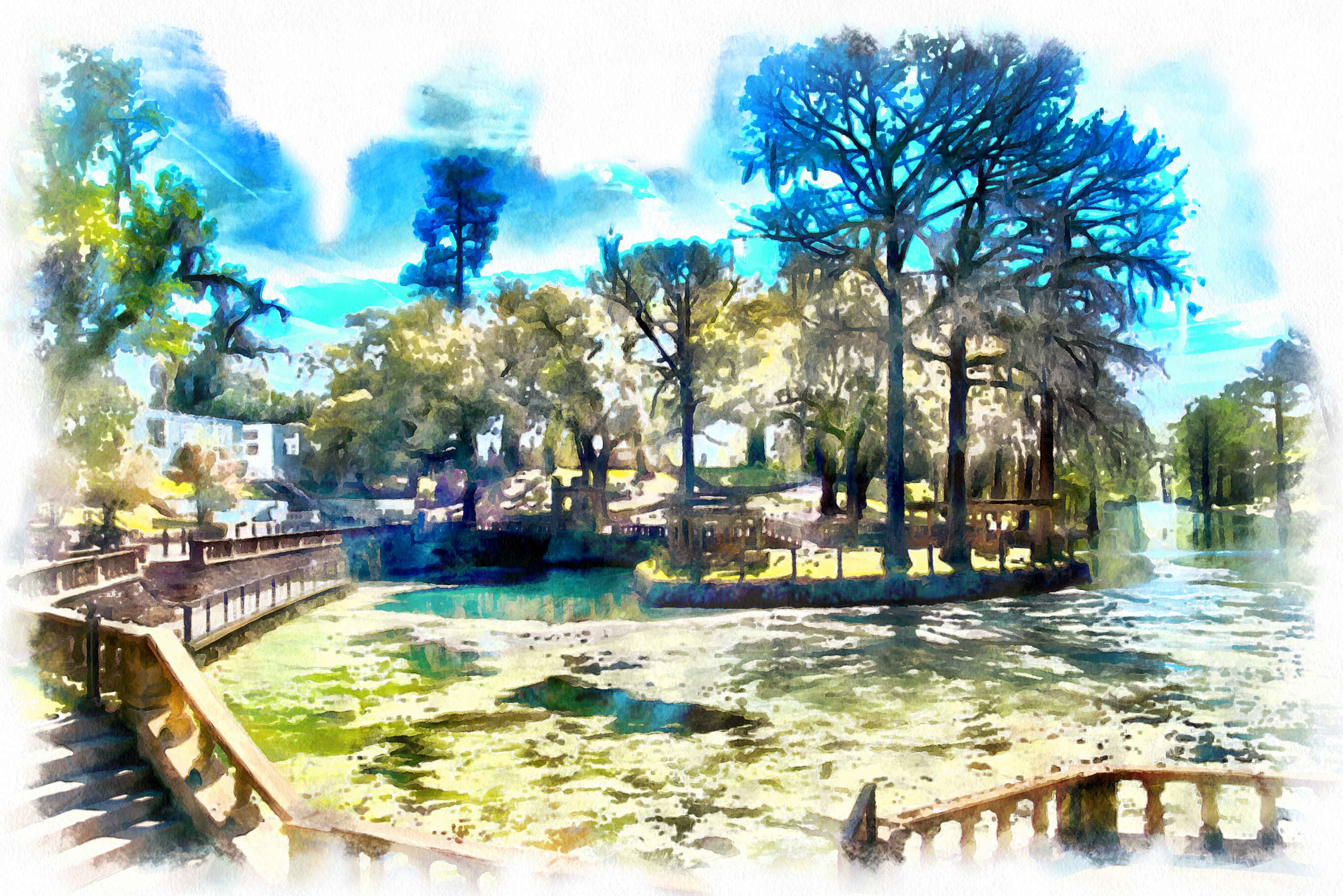
In 1925, Barron Collier, an advertising and real estate mogul whose streetcar advertising empire in New York City brought him great wealth, acquired property in the small South Georgia city of Albany. The indigenous Muscogee called the area “Skywater,” while later European settlers dubbed it “Blue Springs” for the vivid color of its spring water.
The property boasts Georgia’s largest natural spring, discharging 70,000 gallons per minute of crystal-clear, 68-degree water from an underground cave. Soon after Mr. Collier’s purchase, trace amounts of radium were discovered in the spring water, prompting him to rename it “Radium Springs.” At the time, radium was celebrated as a miracle cure, so the springs’ popularity soared, with the spring viewed as a health benefit rather than a hazard.
Mr. Collier was drawn to the property for its proximity to the Atlantic Coast Line Railroad and Highway 19, a major thoroughfare through South Georgia. He renamed it “Skywater Park” and developed an upscale resort and spa.
The Radium Springs Club opened in 1927, offering an 18-hole golf course, private cottages, a spring-fed swimming pool, a boating area, and the Grand Casino building. Although called a casino, it didn’t offer gambling; instead, it featured a ballroom, dining rooms, walkways, and scenic terraces overlooking the springs.
Throughout the 1920s and 1930s, Radium Springs flourished as an elegant venue in Albany, hosting golf tournaments, weddings, conferences, concerts, and other social gatherings.

The Great Depression marked the beginning of the resort’s decline, as visitor numbers dwindled. The pool and recreational facilities were opened to the general public. In 1942, a group of South Georgia entrepreneurs purchased the property, sparking a modest revival.
The decline continued, hastened by the realignment of Highway 19 in the early 1960s, which made access more difficult. In the following decades, the property changed hands multiple times, experiencing a series of reopenings and closures, but never regaining its former elegance.
(Side note: I celebrated a milestone birthday at the Casino in 1980. A wonderful time was had by all.)
A devastating fire in 1982 severely damaged the Casino. Major floods in 1994 and 1998, coupled with drought-related low water levels, ultimately ended recreational activities at Radium Springs.
After the floods, FEMA assumed partial ownership of Radium Springs. It later transferred the property to Dougherty County. The cost and complexity of restoring the Casino proved too great, leading to its demolition in 2003 and the end of an era.
Efforts to restore the area persisted, and in 2010, the reimagined Radium Springs Gardens opened, featuring a botanical garden on the site of the former Casino, along with walking trails and scenic overlooks. The spring remains open to visitors, though swimming and other water-related activities are no longer permitted.
A severe tornado struck Albany in 2017, causing widespread damage. Extensive restoration followed, and today Radium Springs Gardens remains a popular destination.
Here are 20 pictures I took last week (click/tap here to see all 36).


The 2017 tornado caused extensive local damage. Radium Springs Gardens has been restored, but not all of the surrounding upper-income houses have been.


March 22, 2026
Thanks for visiting!
Click/ tap here for Part Two: The Origin Story of Radium Springs
Click/tap here to view all 36 full-size, no-watermark, images at www.ImagesByBill.us
(Comments here or below are welcome)
(Like this story? Click Like below)
I appreciate your support and hope you enjoy my posts! Together, we can keep the creativity flowing and deliver even more engaging content. Thank you for being part of my journey!
Any donations would be greatly appreciated.
Make a one-time donation
Make a monthly donation
Make a yearly donation
Choose an amount
Or enter a custom amount
Your contribution is appreciated.
Your contribution is appreciated.
Your contribution is appreciated.


Leave a Reply